Last night we crossed the continental divide as we drove from Quilotoa to the town of Baños de Agua Santa. We’re still about 6,000 feet above sea level, but all the water on this side of the mountains flows into the Amazon River. The Amazon River isn’t just the world’s largest river, it discharges more water into the ocean than all of the next seven largest rivers in the world combined. Its average output is 7.4 million cubic feet per second – more than 1.6 billion gallons every single minute. My brain can’t really conceptualize that amount of water. It’s probably a lot more water than you’re imagining.
Baños is perfectly positioned to take advantage of all that water. There are thousands of rivers and waterfalls of all sizes, shapes, and colors within just a few miles of town. The city is filled with tourists who have come to play in the water. We are no exception.
Charmaine and I slept in a little too late for breakfast. We had planned to meet Brett and Jess at the hotel restaurant for breakfast, but I guess all the driving and hiking yesterday wore us out a little more than we thought. They said breakfast was amazing. It was so amazing that we decided to eat dinner at the hotel restaurant tonight instead of venturing back into town. Expectations are high.
Baños is for tourists

Parking in Baños
After missing breakfast we hopped in the car and drove the short couple of miles from our hotel back into downtown. I thought we got a pretty early start, but Baños was already packed with tourists and traffic by the time we arrived. As you can imagine, parking was not super easy. As soon as we parked, someone came over and asked us to pay him to watch our car. It seemed a little sketchy at first and I wasn’t sure what to think about it, but we quickly decided it was better to pay a small amount to encourage him to watch our car than to not pay and possibly encourage him to teach us a lesson. As we walked the short distance from where we parked to the tour office, we verified that he was actually an official parking person for the city. Either way, I think it was the right choice to pay a little, and when we returned at the end of the day, our car was fine.

Ivagatours and Crepes. Is this photo still on their homepage?
Ivagatours Baños
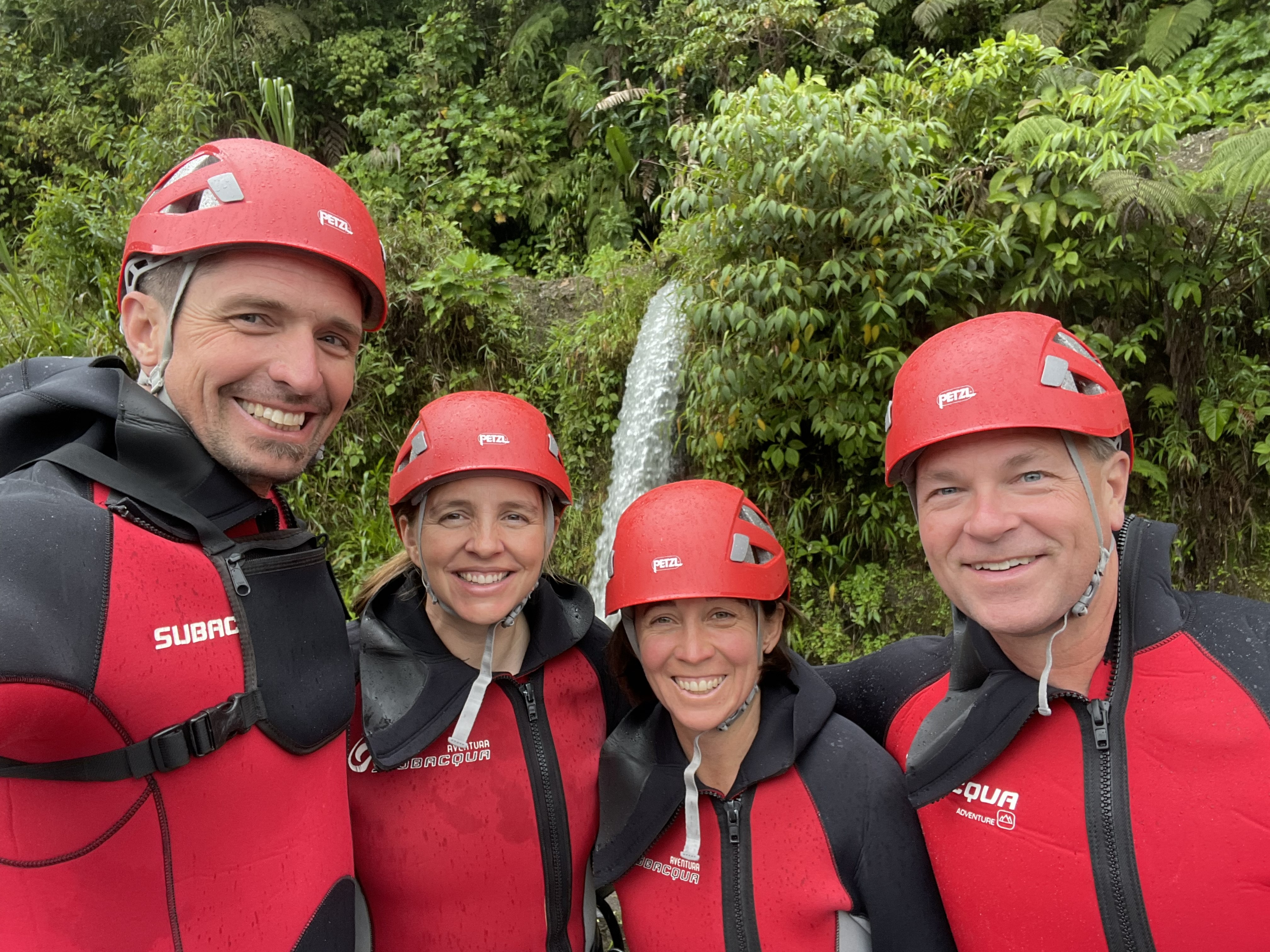
It was a short walk from our parking spot to the office where we met our guides, got fitted for equipment, etc. Brett and Charmaine saw a Creperia across the street. The Nutella and banana crepes worked out especially well for those of us who may have slept in through breakfast. With our equipment in one hand and our crepes in the other, we thought we were ready, but first we needed a photo. Ivagatours Baños liked the picture enough to feature it on their home page. After that we piled into a van and headed south along the Pastaza River to Cashaurco Canyon. Side note: The Pastaza River is the largest triburary (by volume) of the Marañón River, which is the principle source of the Amazon River. It takes a lot of rain to keep that much water flowing.

Perfect weather to enter a slot canyon?
It rains in the rainforest
It was raining in town and it continued to rain the whole drive down river. We eventually stopped at an abandoned restaurant where we stripped down and changed into wetsuits for the adventure ahead. The building was right across the street from a bridge over the river we were about to canyoneer.
The water seemed high to us. Where we are from, you would never consider going into a canyon in the rain, so we were a little concerned. Our guides said we didn’t need to worry. The water wasn’t all that high – they have gone through this canyon when the water was even higher – not with a group, but they have done it. Some of us must not have looked very convinced, so they explained to us that the rain forest rarely floods. These rivers are very accustomed to days and days of rain. But they also gave us instructions about watching for drastic changes in the water color, because that’s a strong sign that a flash flood is imminent. If the water turns dark, stay put and hold on. Luckily we never had to do anything like that. The water stayed clear all day and we had a great time.
Canyon(eer)ing
I haven’t done a lot of canyoning (or “canyoneering” if you’re from Utah), but we had a pretty good idea what to expect based on our recent canyoning adventure in Slovenia. Today’s tour was a lot shorter, with falls and obstacles much closer together. It also involved several different methods of getting down the canyon. Instead of just rappelling or swimming down the canyon, we used all sorts of methods to get over obstacles and down particularly crazy sets of falls. Sometimes we used makeshift zip-lines. Sometimes we jumped into boiling pools at the bottom of steep falls with an anchor line we could use to pull ourselves to safety. It was really a lot of fun.
Brett had his waterproof phone case, so he was able to shoot some fun videos. The tour guides had a GoPro and the tour company gave us access to all the videos and other pictures they took, but they don’t compare to the quality of the shots Brett took.
My warm-up dive
Warm-up waterfalls
The very first thing they did was dunk each of us individually in the river and have us prove to them that we could float using our wetsuit (and that we were not afraid of the water). Right after that they had us stand at the edge of a small waterfall, face upstream, cross our arms over our chests, and then let them lean us back until we went down over the falls head first. I think the point of the exercise - besides being fun - was to help us trust them and show them that we did. Trusting your guides is extremely important in this type of terrain and these guys really seemed to know what they were doing.
The next waterfall was a little higher and they said we could dive into the pool below it. So I did. I wasn’t 100% sure it was deep enough, so I pulled up quick to keep the dive shallow. That was a great way to start things off for me.
Do I really need the rope?
A leap of faith
The pool at the bottom of the next waterfall was really boiling. The jump was a bit higher, but nothing crazy. The real challenge was getting yourself out of the bubbling water after making the jump. To make sure we didn’t get trapped down there, they strung a rope through our harness and then pulled it tight from both ends once we were in the cauldron. That made it pretty easy to pull ourselves along the rope to safety. I don’t think anyone could get out of that hole without a rope or some other type of help. I’m not sure I really understood what I was getting into when I casually just jumped from the ledge. It sure was fun.
Directly after that we stood atop a series of falls bouncing back and forth. It’s clearly possible to rappel down (our guide did it), but it looked pretty gnarly. Instead of trying to rappel through the crazy shifting current, they setup a makeshift zip-line to let us sail down the two or three sets of fast-moving falls.


Do not step into the watefall here
Rappelling at last
Next we floated down a few sections of the canyon and then did some rappelling. I’m still not a huge fan of rappelling, but it does allow you to get to some really cool places. This was one of them. Actually, one of the descents was right next to a huge roaring fall that looked crazy. We continued down through a few more waterfalls, but the real star of the show for me was the boiling pool that we jumped directly into. That’s an experience that I’ll remember for a very long time.


After the final obstacle, we climbed directly up from the river to the abandoned restaurant where we started. At the restaurant we changed back into our clothes and jumped back in the van for the ride back to Baños. It wasn’t the longest canyon. It didn’t have the biggest or the most obstacles. But somehow it still turned out to be one of our favorites.